How Provably Fair Systems Work in Online Casino Games
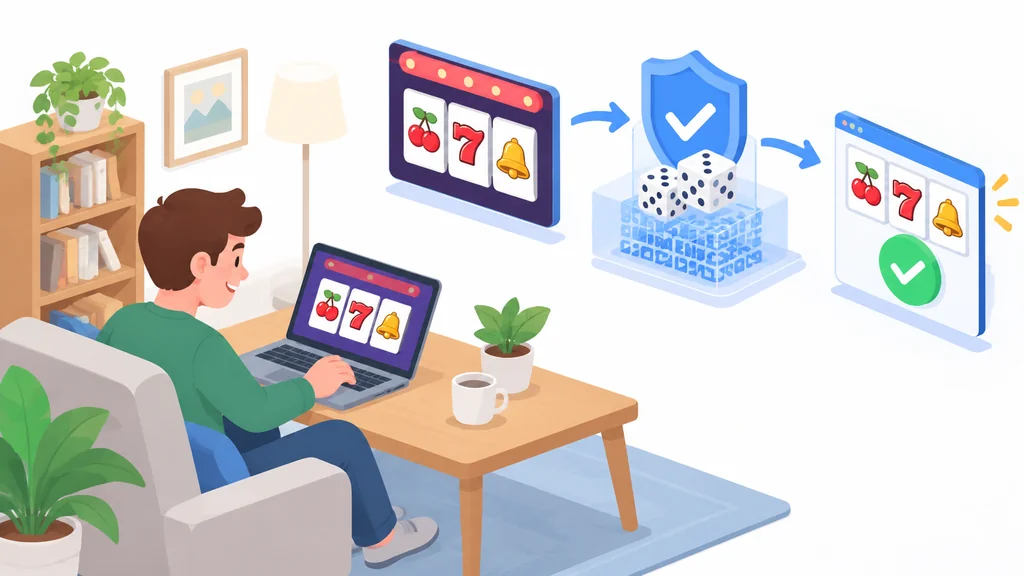
A provably fair system is a commit-reveal scheme. The casino locks in a secret input before you place a bet, publishes a fingerprint of that input, then reveals the input after the round so that you can recompute the result yourself. That single trick shows the outcome was settled before your money moved, and it says nothing at all about whether the payout table is generous or whether a withdrawal will be approved.
What “Provably Fair” Promises
The label describes a mechanism, and a mechanism is something a site either builds or does not build. There is no inspector who stamps a game “provably fair” in the way a testing lab stamps a slot, so the first useful move is to find the fairness page and see what it actually publishes. A real implementation gives you a hashed server seed, a place to set your own seed, a nonce attached to each bet, and a verifier that takes those values and returns an outcome.
A hash function is the workhorse. It takes any piece of text and returns a fixed-length fingerprint, and it does so in a way you can repeat exactly on your own machine. Change one character of the input and the fingerprint changes completely and unpredictably. You cannot work backwards from the fingerprint to the text that produced it, which is why the site can show you the fingerprint before the round without giving the game away.
That ordering is the whole point. A hand of Blackjack, a spin of Roulette or a roll of the dice is settled by inputs that were already frozen, and the fingerprint you copied before betting is your evidence of the freeze. After the round the site hands over the secret input, and if hashing it reproduces your fingerprint, that input existed in that exact form when you placed the bet.
The Seeds and the Nonce Behind Each Round
The inputs are easy to list. The server seed is a long random string the site generates and keeps secret until it is rotated. The client seed is a string you control, and good implementations let you type a new one at any time. The nonce is a counter that changes with every bet, so the same pair of seeds never has to produce the same result twice.
They are combined in a published order and run through a hash function, often with a keyed construction such as HMAC, and then a documented mapping turns part of the hash output into a card, a number or a reel position. The mapping matters as much as the hash, because the hash only produces a stream of characters and something has to decide that this stream means a seven of hearts.
Your client seed exists so that you contribute part of the input. Because it is yours and the nonce changes with every bet, the same server seed produces a different stream of results for you than it does for another player, and you can reproduce your own stream exactly as long as you kept all the values. Changing the client seed does not rewrite past results, it only changes the stream going forward.
The server seed has to stay secret while it is in use. If a site published it before the round, you could compute every future result from it, which is why you see the hash during play and the raw string only after a rotation. Rotation is the moment the old seed becomes public and a fresh hidden one takes its place.

How to Verify a Round Step by Step
The checking itself takes a few minutes and needs nothing but a copy buffer and somewhere to keep notes.
- Open the fairness page and copy the hashed server seed exactly as it stands, before you place the bet you want to check.
- Set a client seed you will remember, then copy it character for character, including spaces and capitals.
- Record the nonce that belongs to the bet, and note the round identifier if the site shows one.
- Play the round and keep your own record of what happened, whether that is a card sequence, a number or a reel result.
- Rotate the server seed when you are ready, or wait for the site to rotate it, and copy the revealed raw seed.
- Hash the revealed seed with the function the site documents and compare the output with the fingerprint you saved earlier. An identical match means the seed was fixed in advance.
- Enter the revealed seed, your client seed and the nonce into the verifier, then read the outcome it computes.
- Compare that computed outcome with the one you recorded, and if they differ, save screenshots of everything before you contact support.
A match across those steps means the round was produced from the inputs the site committed to. A mismatch means something went wrong, and the most common cause is a typo or a wrong nonce, so repeat the check before assuming bad faith. Running at least one round through a separate implementation of the published function is a reasonable habit if the stakes are high, since the site’s own verifier is still the site’s own code.

Where the Proof Stops
Provable fairness covers a specific kind of game, and it stops at the edge of that kind. Some live-dealer tables dealt from a physical shoe fall outside this kind of verification because they do not use a server seed or nonce. A slot supplied by an outside studio can also fall outside the page’s scope when the page lists only the site’s own in-house games. Check which titles the page names before you assume the badge applies to the whole lobby.
Another limit is the mapping. The proof shows the input was fixed before you bet, and it does not show that the mapping from hash to outcome is generous. You can audit that part yourself by running the published function over a long series of hypothetical rounds and comparing the frequency of each result with what the payout table implies, which is slow work and the reason most players never do it.
The last limit is everything outside the game. A perfect hash says nothing about licensing, withdrawal processing or the terms attached to a bonus. Those questions are separate from the game proof, and the fairness page is not a substitute for checking them.
Reading the Payout Table Alongside the Proof
Fairness and value are separate questions, and it helps to keep them apart. A game can be perfectly provably fair and still pay less than another version of the same game, because the difference lives in the rules panel. A Baccarat table with a commission on the banker bet, a Punto Banco variant with different tie treatment and a Blackjack table with different dealer draw rules all produce different long-run returns from the same fair shuffle.
So the routine is to read the rules before you read the fairness page. Look at what a winning hand pays, how ties are settled and whether the table uses one deck or several. Those details set the house edge, and the edge is what a betting plan has to survive, which is why the bankroll management math behind limits that actually hold is worth as much attention as any proof.
A provably fair result is also one result. A run of rounds is a distribution, and the shape of that distribution is what decides whether a session goes well. The integrity of a single round is a different question.

Mistakes That Break Your Verification
The mechanics are simple and the record keeping is where people slip. The fingerprint you copy has to come from before the round, and once the site rotates its server seed the page shows a hash of the new one, so a late copy proves nothing. Your client seed has to be typed exactly, since a single wrong capital changes the hash completely.
Note the right nonce for the right bet. A nonce that belongs to the previous round will produce a plausible looking outcome that has nothing to do with the round you are checking, and that mismatch is easy to misread as tampering. Keep round numbers, screenshots and a plain text file of seeds and dates, because memory is the weakest part of the chain.
Two larger confusions are worth naming. Using only the site’s own verifier means trusting the same code you are trying to test, so a second implementation is a useful cross-check. Treating a fairness page as a licence is the other one. A provably fair shuffle does not fix the wagering traps hidden in no-deposit bonuses, and it does not change how a casino tournament is scored once you have joined.
When to Ask Support or Walk Away
If a computed outcome does not match the recorded one and you have repeated the check with fresh copies of every value, write to support with the round identifier, the two seeds, the nonce, the fingerprint you saved and the outcome your own computation produced. Ask which version of the function they publish and whether a rotation was pending when you copied the hash. A support team that can answer those questions is a good sign, and a site that cannot explain its own fairness page is telling you something by omission.
The terms are a separate conversation. Deposit limits, withdrawal rules and identity checks all live in the terms, and where those rules differ between operators they genuinely differ, so the terms page and a written reply from support are the places to look. Keep those replies, because a copy of what you were told is worth more than a recollection of it. Your deposit method, whether a card, Bitcoin or Ethereum, does not change how the hash works or how the withdrawal rules are written.
Provably Fair Games FAQ
What does provably fair actually prove?
It proves that the inputs which produced a result were fixed before you bet and were not altered afterwards. You confirm that by hashing a revealed seed and matching it to the fingerprint you copied earlier. It does not prove that the payout rules are good, that the site is licensed or that a withdrawal will be paid.
Can a casino fake the verification?
A site could publish a verifier that hides what it does, which is why a second implementation of the published function matters. If the documented function is genuinely published, anyone can reimplement it and check the same numbers. A fairness page with no published function, no seeds and no nonce is a page with nothing to verify.
Do I need to check every single bet?
No. Checking a round now and then, especially a large one or a run that feels wrong, is enough for most players. The values you need keep changing, so the practical routine is to save the fingerprint and client seed before a session and check a few rounds afterwards.
Does a provably fair game have no house edge?
No. The proof concerns how the result is generated, and the edge comes from the payout table attached to that result. A fair shuffle of a game with poor rules still loses money over time, so read the rules panel as well as the fairness page.
What should I do if I lose my saved hash?
You can still check future rounds, but the old ones become hard to verify because the fingerprint from before the bet is the anchor. Some sites keep a history of previous fingerprints, and if yours does, copy it into your notes before the next rotation.