Bankroll Management for Online Casino Play: The Math Behind Limits That Actually Hold

A bankroll limit only works if it’s sized as a percentage of your total bankroll. The standard range is 1–2% per unit. A round dollar figure picked for tidiness skips that math entirely. Your plan rests on two numbers: your unit size (the amount per bet) and your stop-loss threshold (the point where you walk away). This is a math method for discipline. The house edge stays exactly where it started. No bankroll formula changes expected value. It only changes how long a bankroll survives and how firmly you hold your stopping point. This piece uses CAD amounts throughout, easy to adapt to any currency.
18+ only. Gambling carries risk. If gambling stops being fun, help is available. See Section 6.
Why Round-Number Limits Fail
A fixed dollar limit ignores the size of your bankroll and the variance of the game you’re playing. Pick a number because it’s tidy, and you’ve disconnected the limit from the math that should set it.
A flat number creates a mismatch, because the same dollar figure means something different on every bankroll.
| Bankroll | $50 stop-loss as a share |
| $200 | 25% |
| $2,000 | 2.5% |
On the smaller bankroll that’s a deep cut, one that can end a session fast. On the larger one it’s so shallow you’ll hit it on ordinary swings and quit while the session is still statistically neutral.
Variance is the other half. Short sessions are dominated by luck, not skill. That’s true for slots, roulette, and most table games. A fixed limit that ignores the natural swing of the game will either cut you off too early or let you bleed past the point where the math says stop.
The psychology makes it worse. When a limit is arbitrary, it’s easy to move it. “Just $20 more” is a common thought, because nothing in the number itself explains why it should hold. Loss-chasing is one of the most common reasons players abandon their own rules, a pattern covered in why people love online gambling and the psychology behind it. A percentage-based limit has a reason behind it, and that reason is what makes it stick.
Sizing the limit relative to the bankroll gives the number its own logic.
The Unit-Sizing Method: 1–2% Per Bet
A unit is the amount you bet on a single wager, computed from your total bankroll. The convention is 1–2% of your bankroll per unit. That works out to about five to ten dollars per bet.
Small units matter because a losing streak needs to be survivable. Consider sizing each bet at ten percent of the bankroll instead. That would be $50 on a $500 bankroll. Four losses in a row and you’re down $200, which is 40% of your bankroll. At that point, the math of recovery gets brutal. You need a 67% return on what’s left just to get back to even. That’s simple arithmetic at work.
At 2% per unit, the same four-loss streak costs $40. That is 8% of the bankroll. You’re still in the game, and the bet sizing hasn’t changed the house edge one bit. What it’s changed is your survival time.
The math reason for that comes down to variance and skill.
A $500 bankroll makes the pattern clear.
| Unit % | Unit size | Loss streak (5 bets) | Bankroll remaining |
| 1% | $5 | $25 | $475 |
| 2% | $10 | $50 | $450 |
| 5% | $25 | $125 | $375 |
| 10% | $50 | $250 | $250 |
The bottom row shows how much a losing streak can cost at that size. Five losses at that unit level halves your bankroll. At 2%, you’ve lost about a tenth of it. That’s uncomfortable, but you’re still playing with a real bankroll tomorrow.
Setting a Session Stop-Loss (and a Stop-Win)
The stop-loss convention I use is 20–30% of your session allocation. If you’ve set aside $500 for a session, the stop-loss falls somewhere between a hundred and a hundred fifty dollars down. That works out to ten to fifteen units at that same per-bet size.
The stop-loss does two jobs. First, it caps the damage of a bad run. The variance that dominates short sessions turns a losing streak into a plain statistical event, nothing more. Second, it forces a decision point. When you hit the stop-loss, you’re executing a plan you made before the session started, on schedule and by design. I remember one session where the stop-loss did exactly that job. I was down to the threshold with an hour of planned play still ahead, and the discipline of that pre-set number made me close the tab and walk away mid-session. The next day, the bankroll was still intact enough to fund another session without a reload.
Setting the number in advance is what makes it hold.
The stop-win is the mirror image, and most players skip it. If you’re up by that same range on that $500 session, the discipline says stop there too. The reasoning is symmetric. A winning streak is also variance, and the house edge is still working against you the longer you play. Cashing out a win at a predetermined point converts a lucky run into a bankroll increase. Playing through it converts a lucky run back into a donation.
The discipline loop I follow, in order:
- Set the session allocation before you open the casino.
- Compute the unit as 1–2% of the session allocation.
- Set the stop-loss at that same range of the session allocation.
- Set the stop-win at the same percentage figure.
- When either threshold hits, the session is over. No exceptions, no “one more.”
The numbers work as a commitment device you agree to beforehand. The point of writing them down before you play is that you can’t negotiate with yourself mid-session.
Variance vs. Skill: What the Math Actually Says

On games of pure chance, the house edge is fixed, and no unit-sizing method changes it. Slots, roulette, and most table games have a negative expected value regardless of what you do. The math is indifferent to how disciplined your bankroll is.
It only cares how many bets you place.
What bankroll management actually controls is survival time. A smaller unit means more bets before the bankroll is gone. That means more sessions, which means more entertainment per dollar. It’s a system that paces the loss across a fixed house edge.
The Kelly criterion makes this precise. Kelly’s formula, from information theory (Kelly, 1956), calculates the bankroll fraction that maximizes long-run growth for a bet with a known edge, and for negative-expectation games, which is every casino game with a house edge, the same formula returns zero or negative. Mathematically, the optimal bet size is no bet at all. No serious math suggests you can size your way around a house edge.
What about games with skill elements? Blackjack with card counting and poker against other players are different animals. The math changes because the edge shifts with skill. But for the standard online casino catalog, which includes slots, roulette, baccarat, and most blackjack variants, the house edge is structural. Bankroll management keeps you in the game longer. It leaves the odds exactly as they were.
A Worked Example in CAD
The method works with real numbers in Canadian dollars.
The setup. You’ve set aside $500 CAD for online casino play this month. That’s your bankroll. It’s money you can afford to lose entirely, separate from rent, groceries, or savings.
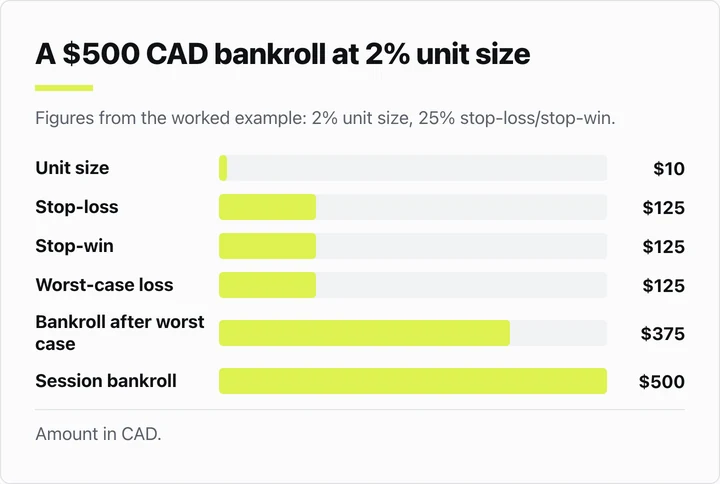
First, compute the unit. At 2%, your unit is $10. At 1%, it’s $5. I’ll use that same amount for this example because it makes the arithmetic cleaner, but both are defensible.
Second, set the stop-loss. At 25% of the session allocation, that’s $125. In units, that’s 12.5 units. I’d round to stopping after 12 losing units, at $120 down.
Third, set the stop-win. Same figure. That’s $125 up, or 12.5 units. When you’re ahead by that margin, the session ends.
This example touches every figure at once.
| Item | Amount (CAD) | Units |
| Session bankroll | $500 | 50 |
| Unit size (2%) | $10 | 1 |
| Stop-loss (25%) | $125 | 12.5 |
| Stop-win (25%) | $125 | 12.5 |
| Worst-case session loss | $125 | 12.5 |
| Bankroll after worst case | $375 | 37.5 |
The worst case matters. If you hit the stop-loss every session for four sessions straight, you’re down $500. That’s the whole bankroll. Even with discipline, you can lose everything over enough losing sessions. What the method does is spread that outcome across four separate sessions, turning one tilted night into a slower, survivable drift.
The same example at 1% units works differently. You’d bet $5 per unit, and the stop-loss stays at that same dollar figure described above. That works out to twenty-five units. Smaller units mean more bets before you hit the threshold. That means longer sessions and more play for the same worst-case loss.
Where to Get Outside Help in Canada
Bankroll management is a tool for keeping play recreational. If gambling stops feeling recreational, and you’re chasing losses, hiding play, or spending money you can’t afford, help is the thing to reach for.
Two Canadian resources are worth knowing about before you ever need them.

ConnexOntario is a publicly funded, confidential 24/7 helpline and information service for problem gambling and other addictions in Ontario. You can call, text, or chat online, and the service is free. It welcomes calls even when there’s no crisis at all. You can reach out because you have questions about your own play or someone else’s. Their website is connexontario.ca.
The Responsible Gambling Council is a Canadian non-profit that provides player-facing education and links to provincial self-exclusion and help programs. It lists the warning signs and links to help programs specific to your province. Their website is responsiblegambling.org.
Both organizations exist to help, without judgment. Checking in with yourself about your gambling is the same discipline as setting a stop-loss. It’s a plan you make before you need it.
18+. If gambling is causing harm, help is available. Call ConnexOntario in Ontario, or visit the Responsible Gambling Council online at responsiblegambling.org.
FAQ
Does a bigger bankroll mean a bigger unit percentage? No. The percentage stays at 1–2% regardless of bankroll size. A five-thousand-dollar bankroll at 2% gives a $100 unit. A $500 bankroll at 2% gives a unit matching the worked example above. The percentage is the constant. The dollar amount scales with the bankroll. What changes with a bigger bankroll is the absolute size of your bets. The risk per bet, as a percentage, stays the same.
Does unit sizing improve my odds? No. Unit sizing leaves the house edge and the expected value of any bet exactly where they started. What it changes is how long your bankroll lasts and how much of it you can lose in a single session. Unit sizing leaves your odds of winning unchanged. It makes you less likely to lose everything in one night.
What’s a reasonable stop-loss? The common convention is twenty to thirty percent of your session allocation. On that same $500 session, the stop-loss lands in the same range as above. The exact figure matters less than the commitment to it. A stop-loss you ignore is a number, not a limit. Pick the percentage before you play and treat it as binding.
Should stop-win be the same as stop-loss? Yes, for most players. The symmetry is the point. Both a losing streak and a winning streak are variance, and the house edge works against you the longer you play. Cashing out a win at a predetermined point protects the profit the same way the stop-loss protects the bankroll. If you’re up by that same stop-loss percentage on a session, the math says the session has served its purpose.
Does this apply to tournaments? Tournaments use different bankroll math because the cost structure is different. You pay a buy-in for a shot at a prize pool, and the bankroll question becomes how many buy-ins you can afford. If you’re curious about the format, our guide to online casino tournaments and how to join them covers the buy-in math in more detail.
Is 1% too conservative? For a recreational player, no. A one-percent unit means a $5 bet on a $500 bankroll. It’s small, but it stretches the bankroll across far more sessions than a 2% unit. The tradeoff is entertainment value. Smaller bets are less exciting. If 1% feels too slow, 2% is the ceiling most bankroll guides recommend. Above 2%, losing streaks start to compound in ways that threaten the bankroll itself.