No-Deposit Bonuses: The Hidden Wagering Traps to Check First

A no-deposit bonus is worth roughly zero in expected value most of the time, and the wagering requirement is the reason. The headline says “free $10.” The terms say you must wager that credit, plus any winnings from it, a set number of times before a cent leaves the account, and the multiplier is usually high enough that the house edge grinds the whole thing back. The traps stack. A max-cashout cap, a max-bet rule, game weighting and an expiry clock all sit on top of the multiplier. Read the multiplier first, then read everything that limits it. What follows is how each layer works and what it costs in plain arithmetic.
What a wagering requirement actually does
A wagering requirement is a turnover target expressed as a multiple of the bonus. The ranges below reflect multiple current industry guides published in 2026, not one operator’s terms. See the table below for how different multipliers translate to expected value. The multiplier applies only to the bonus amount itself; on winnings it sometimes applies to the bonus plus everything you’ve won from it, which raises the target again.
That turnover is not free to produce. Every bet carries a house edge, charged on the full amount you wager. So the multiplier converts directly into an expected cost.
The formula is short: Expected value = Bonus amount − (Bonus amount × Multiplier × House edge).
A 4% house edge (roughly what a 96% RTP slot charges per spin) applied to common multiplier levels shows why high-requirement offers are inherently negative:
| Requirement | Turnover on $10 | Expected Loss | Net EV |
| 25x (break-even point) | $250 | $10 | $0 |
| 40x (typical offer) | $400 | $16 | −$6 |
| 99x (high-multiplier offer) | $990 | $39.60 | −$29.60 |
Industry guides treat multipliers in the 20–40 range as fair. Anything above 60 is very hard to clear profitably. This threshold is not arbitrary. At a 4% edge, the break-even point is about 25x; below it the bonus can retain some value on average, above it the player is subsidizing the operator. The table treats the multiplier as fixed against the bonus alone; when a term applies the multiplier to the bonus plus any winnings generated from it, the real turnover (and the expected loss) runs higher than the simplified figures above.
Why high-multiplier offers resemble lottery tickets
The break-even point matters because it’s where most no-deposit offers fail. Refer to the table above. Every level above the break-even multiplier pushes EV further negative, and for very high requirements the expected loss is so large relative to the bonus that any payout feels like a windfall despite being statistically unlikely.
A negative-EV offer can still pay out. Variance means some players clear the requirement and withdraw, and those stories travel. But the average outcome is a loss, and the distribution is heavily skewed toward zero. A good outcome (cashing out) attached to a mathematically poor decision (taking the offer) is how a bankroll erodes.
The multiplier is also the number most likely to be buried in the terms. Often it’s tucked into a linked terms page, away from the main promotion headline. A multiplier that isn’t visible before opting in is worth treating as a caution sign, not a formality to skip past.
The max-cashout cap: the ceiling nobody reads
A max-cashout cap limits how much of your bonus-derived winnings can ever be withdrawn, regardless of how well you play or how completely you clear the requirement. Typical caps on no-deposit offers are commonly reported in the €50-€100 range, roughly $50-$110 in CAD/USD terms.
Here is the trap in one line. Take that credit with a $100 max cashout attached. You run it up to $450, you clear the full wagering requirement, and you request a withdrawal. The operator pays $100. The remaining $350 is removed at cashout; the cap applies at the moment of withdrawal, regardless of your account balance.
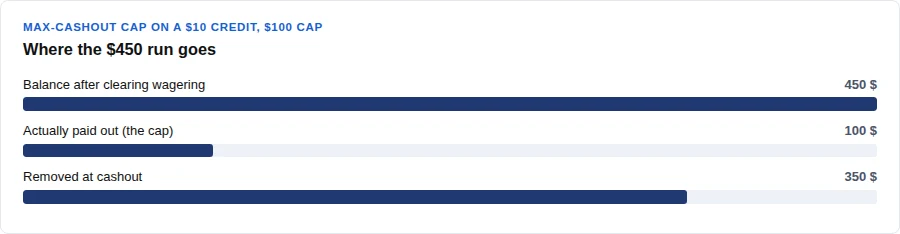
The cap changes the shape of the bet. Without it, a high multiplier is a long shot with a large upside. With it, the upside is truncated at a fixed number while the downside, the time and the variance, is unchanged. Truncating the right tail of the outcome distribution lowers EV further, and it does so silently, because the cap is usually a single line in a terms page.
Two questions matter before opting in. What is the maximum withdrawable from this bonus, and does the cap apply to winnings only or to the bonus as well? On most no-deposit offers, the answer to the first question is a figure well below what a lucky run would produce.
The max-bet rule: one spin can void everything
The max-bet rule caps how much you can stake per spin or per hand while bonus funds are active. Typical ceilings are $5 or less, and enforcement is strict. Exceeding it, even on a single accidental spin, is standard grounds for the operator to void the bonus and every winning generated from it.
This is the trap that catches experienced players, since a single accidental slip triggers it regardless of skill. A mis-click on a higher-stake slot, a game that defaults to a high bet, a live table with a minimum above the cap can all void the entire bonus. The rule is usually stated, but it sits in the same block as the multiplier and the weighting, tucked among the terms with the harshest penalty for violation.
The practical implication is that a no-deposit bonus restricts which games you can play at all. A high-limit table, a jackpot slot with a fixed stake, anything with a minimum above the cap is off the table while the bonus is live, even if the game weighting would otherwise make it a sensible choice. Check the cap before placing the first spin.
Game weighting: why roulette barely counts
Game weighting is the percentage of each bet that counts toward the wagering requirement, and it varies by game category. Slots and scratch cards are weighted highest. Table games such as roulette, baccarat, craps, and video poker are weighted far lower, and virtual blackjack often sits lower still.

This weighting reflects the house edge. Games with lower house edges are weighted lower precisely because they’re less profitable for the operator. A player who clears a requirement on such a game costs the house less per bet, so the operator reduces how much of that bet counts, preserving the expected margin. The practical effect on a single turnover requirement, by game category:
| Nominal Requirement | Slots (100%) | Roulette (20%) | Blackjack (10%) |
| $400 | $400 real wagers | $2,000 real wagers | $4,000 real wagers |
A requirement cleared on slots matches the nominal amount shown in the table. The same requirement on roulette requires five times the real turnover, because only a fraction of each bet counts. On blackjack the work quadruples again. The multiplier itself doesn’t change, but the grind does.
This is also where the offer’s internal logic shows. The terms push players toward high-edge slots, where the operator’s margin is largest, by making every other category count for a fraction of its face value. A player who wants the lowest possible cost per unit of turnover is steered away from exactly the games that would provide it.
The expiry clock and the forfeit rule
Wagering windows on deposit-match style promotions typically run 7 to 30 days. Winnings derived from free spins often carry a much tighter window, sometimes as short as a single day.
The forfeit rule is the sting. If the window closes before the requirement is complete, the remaining bonus and any winnings generated from it are typically forfeited in full. Not partially, not pro-rated against the percentage cleared. A player who has cleared 90% of a 99x requirement and runs out of time loses the bonus and the winnings, having already paid the expected loss on the turnover completed.
Combined with the multiplier, the clock sets a floor on how fast you must bet to have any chance of clearing, which pushes stake sizes up, which collides with the max-bet rule. The three constraints interact closely. The multiplier sets the total turnover, the window sets the deadline, and the max-bet rule caps how much you can stake to meet that deadline. On a very high requirement with a tight window and a low cap, the math becomes impossible; in some combinations, clearing in time is not achievable even with perfect play.
What to read before you opt in
The terms are long, but the decision hinges on a short list. In order of how much they change the EV:
- The multiplier. Anything above roughly 25x at a 4% edge is negative on average. Above 60x it’s very hard to clear profitably.
- The max-cashout cap. The ceiling on withdrawal, and whether it applies to winnings only.
- The max-bet rule. The per-spin ceiling while bonus funds are active, and the penalty for breaching it.
- Game weighting. The percentage that counts toward turnover for each category you might play.
- The expiry window and forfeit rule. When the clock starts and what happens to a partially cleared requirement.
- Whether the requirement applies to the bonus alone or to bonus plus winnings. The second version raises the turnover target.
If the multiplier and the cap aren’t both visible before opt-in, the offer can’t be evaluated, and an offer that can’t be evaluated shouldn’t be taken. This is the same discipline that applies to any bankroll decision. The size of the bet matters less than whether the terms of the bet are known. The site’s breakdown of bankroll management math covers the same principle from the balance side, and the psychology of why players take these offers anyway explains why the “free” framing is so effective despite the arithmetic.
The bottom line on “free” credit
A no-deposit bonus is a marketing instrument with a negative expected value for the average player, and the traps described above are a structural feature of how this category of offer is typically built. The multiplier sets the cost, the max-cashout cap truncates the upside, the max-bet rule removes the bonus on a single slip, game weighting multiplies the real work required, and the expiry clock forfeits everything if the pace isn’t met. Each constraint alone is survivable. Stacked together, they turn a modest credit into a near-zero-EV proposition with a small chance of a limited payout.
None of that makes playing wrong. It makes the offer a form of entertainment with a price attached. Treating it as a small, capped, negative-EV lottery ticket is a defensible decision. Treating it as free money is where the arithmetic stops protecting the player.
This arithmetic is for players 18 and older, in jurisdictions where online gambling is legal, and it’s meant as a tool for evaluating a promotion before opting in. Gambling should stay entertainment with a fixed, affordable cost, and the resources below exist for when it stops being that.
FAQ
Is a no-deposit bonus ever worth taking?
Sometimes, if the multiplier is low, the max-cashout cap is generous and the game weighting on the games you actually want to play is close to full value. Those conditions are uncommon. On a typical high-multiplier offer with a modest cashout cap, the expected value is negative, and the offer is best treated as entertainment.
What wagering requirement counts as fair?
Industry guides generally treat 20x-40x as fair and anything above roughly 60x as very hard to clear profitably. At a 4% house edge, the break-even multiplier is about 25x. Below it the bonus can be worth something on average; above it the player is subsidizing the operator.
Does the max-cashout cap apply even if I clear the full wagering requirement?
Yes. The cap limits the withdrawal regardless of how completely the requirement is met. A player who turns a small credit into a much larger balance and clears everything can still be paid only the cap, with the remainder removed at cashout.
What happens if I accidentally bet more than the max-bet rule allows?
Standard terms allow the operator to void the bonus and all winnings generated from it. The breach doesn’t have to be deliberate, and a single spin above the cap is usually enough. Check the per-spin limit before the first bet.
Why does roulette count for less than slots?
Game weighting reflects the house edge, as the table above shows. Low-edge table games are weighted far below slots because they cost the operator less per bet. The effect is that clearing the requirement on those games takes several times the real turnover.
What happens if the wagering window expires before I finish?
The remaining bonus and any winnings from it are typically forfeited in full, even if most of the requirement was already cleared. Deposit-match-style windows commonly run several weeks, and free-spin winnings sometimes carry a window as short as a single day.
Where can I get help if gambling stops being entertainment?
Every Canadian province and territory funds its own free helpline and self-exclusion program. The list below covers five of the largest provincial programs; a player elsewhere in Canada can reach an equivalent service through their own provincial or territorial health authority.
- Ontario. ConnexOntario, phone 1-866-531-2600, with self-exclusion through PlaySmart/BetGuard.
- British Columbia. BC Gambling Support Line, phone 1-888-795-6111, with self-exclusion through Game Break.
- Alberta. Alberta Health Services Addiction Hotline, phone 1-866-332-2322, plus the provincial Self-Exclusion Program.
- Quebec. Jeu Aide et Référence, phone 1-800-461-0140, available in French and English.
- Manitoba. Manitoba Gambling Helpline, phone 1-800-463-1554, available around the clock.

These services are free and confidential.